A Very Brief History
The founder of Judo was Jigoro Kano. He was born in 1860 and graduated from Tokyo Imperial University in 1881 with a degree in literature. The following year he took a further degree in philosophy. Kano was also a leading educationalist and a prominent figure in the Japanese Olympic movement.
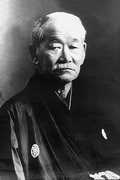 At the age of 18 Kano studied the ju-jutsu
of the Tenshin Shinyo Ryu under Fukudo and Iso, both instructors at the Komu
Sho. Following the death of Fukuda, Kano remained briefly with master Iso before
finishing his pupilage with master Ilkubo.
At the age of 18 Kano studied the ju-jutsu
of the Tenshin Shinyo Ryu under Fukudo and Iso, both instructors at the Komu
Sho. Following the death of Fukuda, Kano remained briefly with master Iso before
finishing his pupilage with master Ilkubo.
By 1883, Kano had learned enough ju-jutsu and other methods to enable him to feel he was able to instruct the public through his own school. He borrowed a room at Eishoji temple and opened the first Kodokan for the study of Kano judo.
A number of back street gyms decided that the Kodokan was conceited and ought to be taught a thing or two. They vandalised its premises and caused so much damage that a challenge match had to be arranged to satisfy honour.
The Kodokan was represented by Sakujiro Yokoyama, the best in the club, and the result was invariably a win for Kano judo.
Kodokan representatives traveled all over Japan, giving demonstrations on the principles of this new method. The last of these demonstrations was a contest, with limb locks and striking excluded, between the Kodokan and the local training school. This very important match took place in 1886 to decide which system of ju-jutsu should be used in military academies, police departments and public schools. The Kodokan team defeated all opponents and judo became a government approved sport.
The 2nd World War was a dark era for Japan. As
part of the war effort, the Japanese instructors had been told to teach unarmed
combat. Retaliating to this, the occupation forces banned all practice of the
martial arts in schools and institutions. This ban remained in force until 1951.
The police were however excepted from the general ban and private instruction in
judo was tolerated.
Because Kano had stood against the worst aspects of
militarism in pre-war Japan, and because of the new draft rules, which removed
the vestiges of judo's martial origin, Kodokan judo was acceptable to the
authorities. This left the Kodokan largely left to
re-establish itself without too many problems.
In 1949 the occupation authorities decided that the Yudanshakai (Dan grade society) could be reformed into a single democratic organization. This formed the Japanese Judo Federation, with headquarters at the Kodokan. Risei Kano, the only son of Jigoro Kano, was president. Today, the President is Jigoro Kano's grandson.
Judo in Britain
In 1899, Mr. E W Barton Wright sponsored a team of
Japanese judo experts in order to start a ju-jutsu school in England. The best
known of these experts was Yukio Tani. He went around the country offering
challengers £1 per minute for every minute they lasted beyond five and £50 if
they defeated him. The prize was rarely (if ever) paid.
He was the first of
many Japanese "showmen" who performed around the country demonstrating tricks
linked with ju-jutsu.
These men were all very capable ju-jutsu experts, but
their main contribution to judo outside Japan was the books they published and
the instruction they gave.
Tani stayed in England and was appointed chief instructor to a new club for "the study of systems developed by the samurai" - the Budokwai in 1920. This was soon to become the most famous judo school outside Japan. Tani continued as instructor until he had a stroke in 1937.
Koizumi first came to Britain in 1906. He then spent
a few years in the USA but returned to Britain to open the Budokwai as a
cultural centre and social club for the Japanese community in London. It
officially opened on 26 January 1918.
For many years it was the only real
source of Kodokan judo in Europe.
In 1948, Koizumi's vision of an international judo
began to materialize. On 24 July, the British Judo Association (BJA) was
established as the national body. A few days later, a meeting chaired by Trevor
Leggett, the most senior non-Japanese player in the world, approved the
beginning of a European Judo Union (EJU) to represent judo in Europe.
Then in
1951, the International Judo Federation (IJF) was formed as an inter-continental
authority.
The rest of the world
Judo spread through many countries between 1902 and
the 1930's. In the United States, President Theodore Roosevelt showed an
interest in judo. Kano sent Yoshiaki Yamashita, a high ranking member of the
Kodokan, to America in 1902 to be the Presidents personal
instructor.
Roosevelt trained regularly, and in due course a room was set
aside at the White House for judo practise.
Clubs were set up in Seattle in
1903 and Los Angeles in 1915.
Australia's first club, Brisbane Judo Club, was
founded in 1928 by DR A J Ross, a Kodokan Dan grade.
New Zealand was reached
in 1948 when G Grundy, a 2nd Dan from the Budokwai, opened a club in
Auckland.